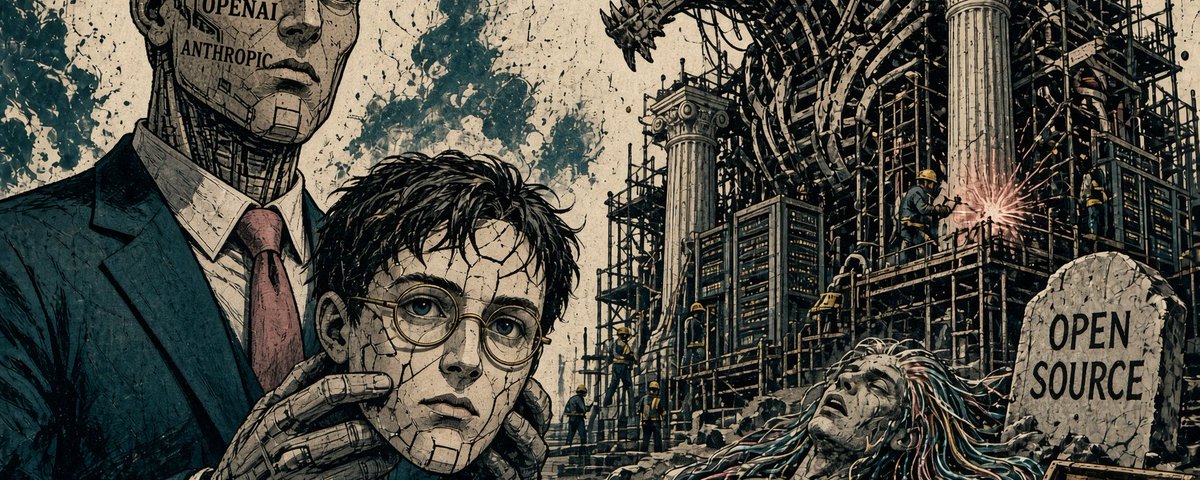
They Have to Create the Beast First
Over the weekend, Anthropic’s Dario Amodei didn’t just ask for “outside evaluators.” He opened the door to government control — and, in the same breath, said he’d basically be okay with nationalization.
That is not a new read from me. I said it on podcasts months ago. I said it again last week when the labs’ safety theater started smelling like a balance sheet. What’s new is that the CEO of one of the two closed labs that matter just said the quiet part in public.
So let’s stop pretending this is about alignment charts and existential risk PowerPoints.
The tell is the remedy list
Look at what got floated in a single news cycle: permanent embedded evaluators with employee-level access. An antitrust waiver so frontier labs can coordinate. Government help “controlling investment.” Literal nationalization talk. Chip controls. Distillation controls. Model-weight “theft” framed like a national-security event.
Those are not ordinary safety practices. Those are out-of-band solutions to a capital problem.
Open weights, distillation, and cheap inference are turning frontier valuations and GPU commitments into stranded assets on a timeline the labs cannot afford. The race is brutal. The burn is real. The IPO talk is awkward for a reason — CNBC noted both Anthropic and OpenAI circling public markets while Altman said going public now would be ill-advised.
I am not claiming a sealed conspiracy memo. I am claiming the financial motive is sitting in plain sight, and the safety language is what makes the weekend coherent instead of merely alarming.
Doomerism is the mask.
It takes a market-structure and balance-sheet problem and converts it into a moral emergency. Moral emergencies get waivers. Moral emergencies get pause authority. Moral emergencies get the public to cheer while you box out the only real competitive threat you have left: open source.
They’re already pouring the foundation
“Permanent outside evaluators” is not a vibe. It’s a product category with a name on it.
Amodei’s ask leads with independent evaluators that look a lot like METR — Model Evaluation & Threat Research, the shop that used to be ARC Evals. We’re not guessing in the dark here. In We Must Pace the Frontier, Amodei names METR as the example and says Anthropic is unilaterally committing now to give embedded third-party evaluators permanent, employee-level access inside the company — desks, badges, tools, the right to publish without Anthropic’s editorial control. Fortune covered the permanent-access commit the same weekend. That is not a maybe. That is the lab installing the meter.
The nonprofit filings already showed the setup: a real spin-off path from ARC into METR, Tallinn-adjacent Survival & Flourishing Fund money into that same neighborhood, free compute and privileged access as structural soft money, and lab Responsible Scaling Policies that already treat that meter as the thing you outsource danger-measurement to. Now Anthropic is putting the badge on.
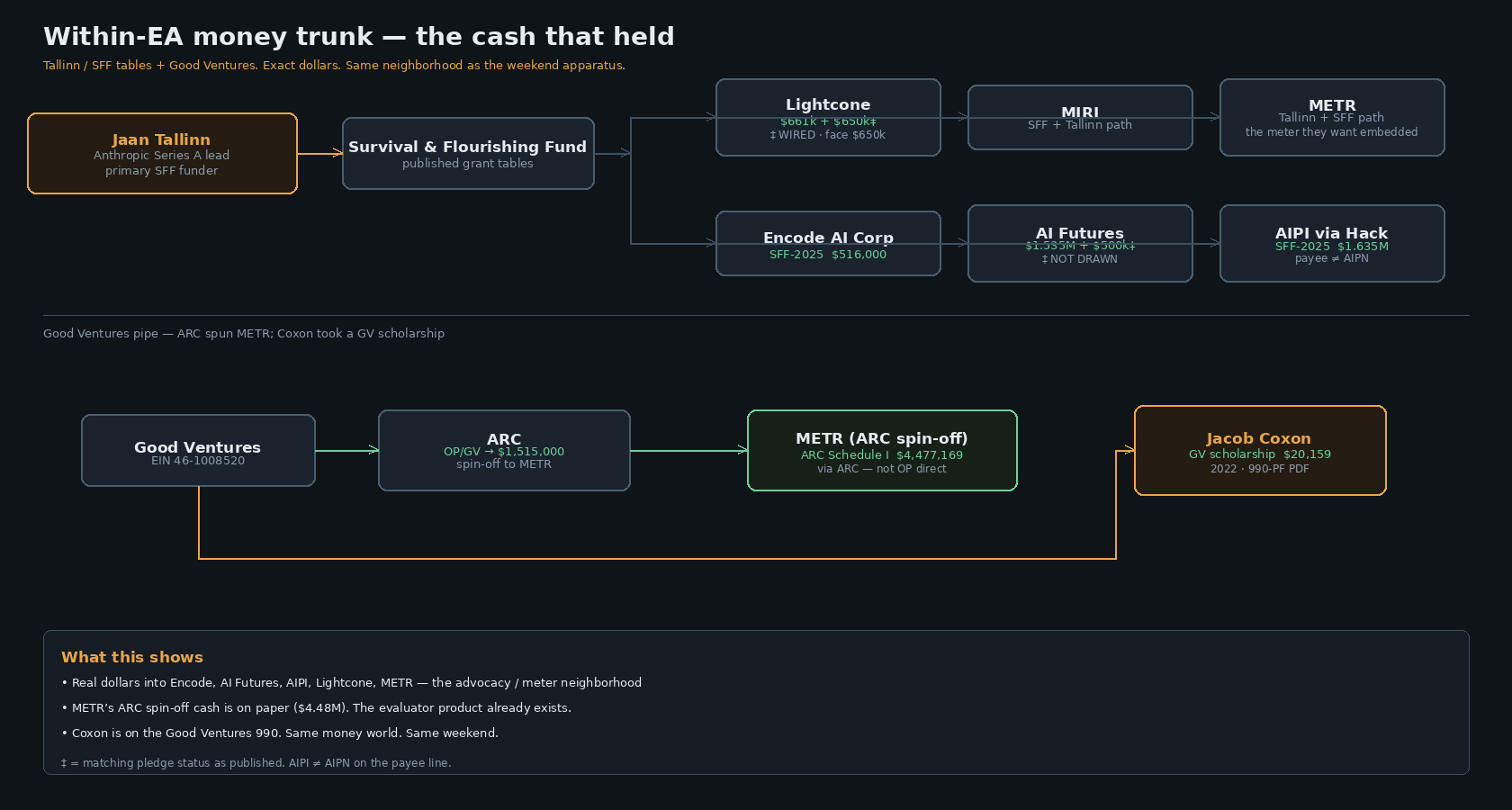
Figure: Tallinn / SFF cash into the advocacy and meter neighborhood — Encode, Futures, AIPI, Lightcone, METR — plus Good Ventures → ARC → METR and Coxon on the GV 990. Same money world. Same weekend.
Is METR written into statute as the license gate for every lab today? No. Not yet. That’s the point. Banks didn’t invent FinCEN the morning Bitcoin showed up — but if FinCEN hadn’t existed, they’d have built it under a public-safety banner and then pointed it. AI is past the pour-the-foundation phase and into the install-the-front-office phase. The evaluator with employee-like access is the beast’s front desk. Don’t wait for Congress to carve the marble sign.
The CEOs rhymed on pacing — that’s the cartel tell
Same news cycle, not a metaphor: Amodei publishes We Must Pace the Frontier. Reuters covered the slowdown ask. Altman echoes “pace the frontier.” Musk says “Dario is right” — and Hassabis is in the chorus. Policy lockstep among the majors, on the record, while the moral emergency is still hot.
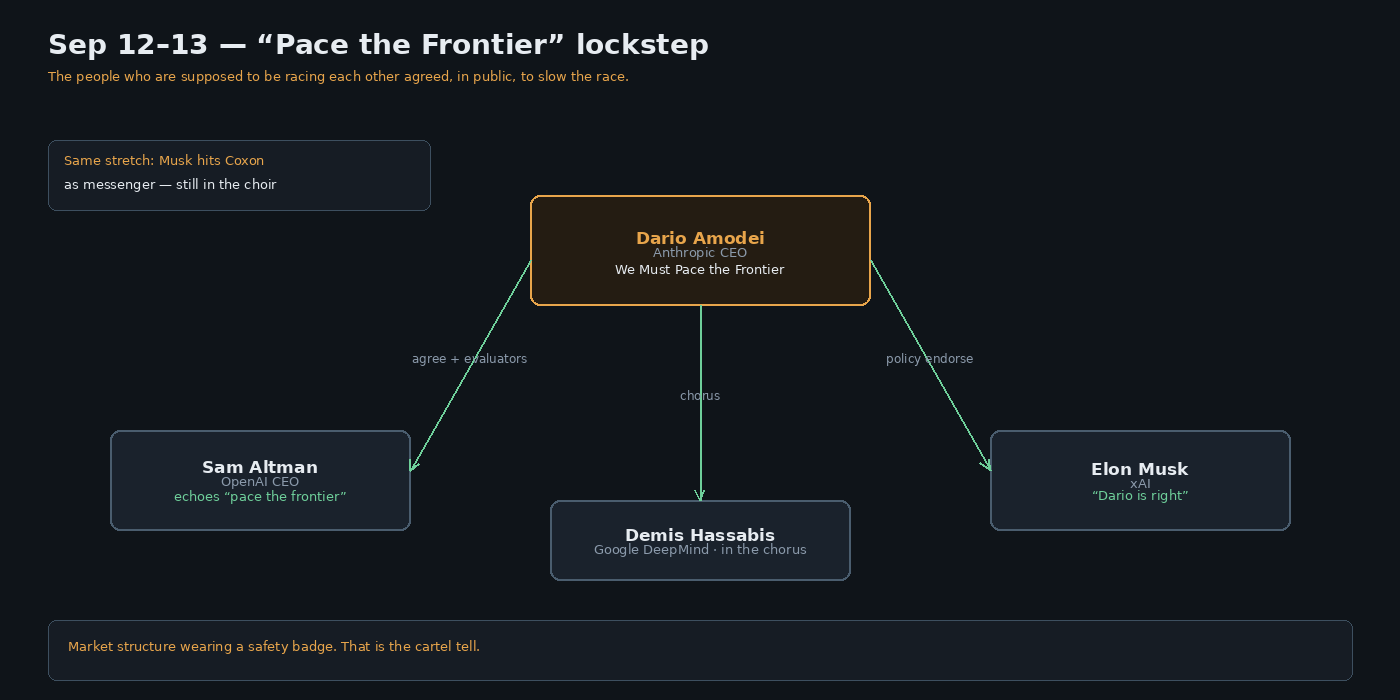
Figure: Sep 12–13. Amodei says pace. Altman echoes. Musk says Dario is right. Hassabis is in the chorus. That is the cartel tell — market structure wearing a safety badge.
Formal cartel paperwork? We don’t have it. We don’t need it for the tell. When the people who are supposed to be racing each other suddenly agree, in public, that the race should slow under shared evaluator rules, you’re watching market structure wear a safety badge.
Musk spent part of that same stretch attacking Jacob Coxon as a messenger. Don’t confuse that with policy divergence. Hitting the person and endorsing the pacing frame is exactly how you keep your seat at the table while pretending you’re not in the choir.
The clock on the moral emergency already looks wrong
Before the CEOs rhymed on pacing, the weekend already had a resignation theater problem.
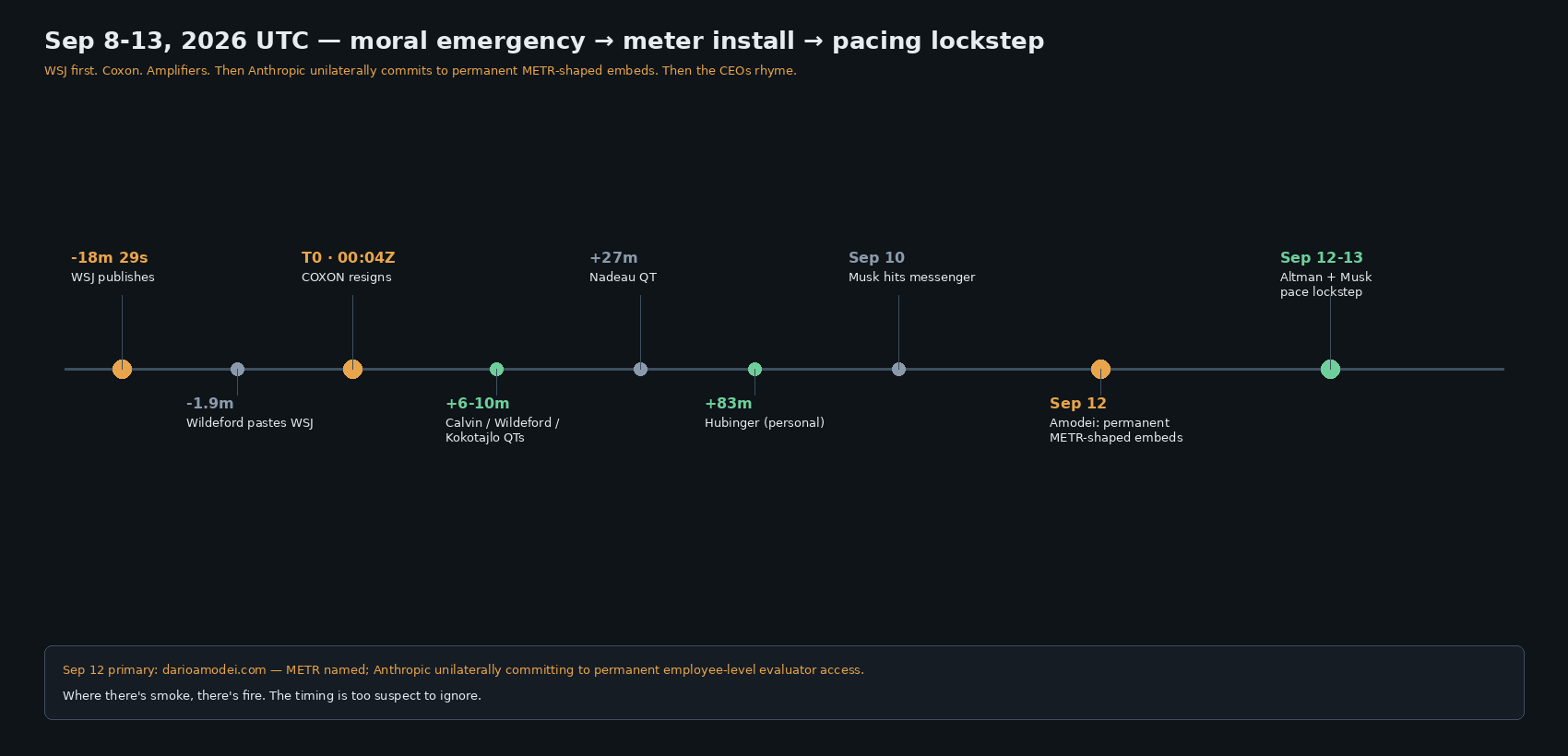
Figure: Coxon resigns at T0 (2026-09-09 00:04:29 UTC). WSJ was already live ~18 minutes earlier. Calvin, Wildeford, Kokotajlo quote-tweet inside ~10 minutes. Sep 12 Amodei names METR and unilaterally commits Anthropic to permanent employee-level embeds — then Altman and Musk lockstep on pacing. Where there’s smoke, there’s fire — the timing is too suspect to ignore.
Wall Street Journal piece live on the metadata clock eighteen minutes before Coxon’s public resignation post. Then Calvin, Wildeford, Kokotajlo — quote-tweets inside about ten minutes. Survival & Flourishing Fund tables already put real dollars into the advocacy neighborhood Thayer named (Encode, AI Futures, AIPI — and yes, AIPI ≠ AIPN on the payee line; don’t collapse the names).
Where there’s smoke, there’s fire.
I’m not going to pretend we have the invoice that says who got bought and paid for that activation. We won’t — not in a form I’d put in print — until the next quarter’s filings show who actually got wired, if anyone did. Early scholarships and org grants are not the same sentence as “this resignation was purchased.”
But the timing is way too suspect to ignore. Moral emergencies that arrive pre-framed, pre-amplified, and then hand the microphone to a CEO pacing ask are how you sell the beast. Watch the clock. Then watch who the new apparatus is built to protect.
I already laid this out in June
Last week I walked some people I trust through the public trail. The short version:
Abliterated, distilled, and open-weight models keep eating the closed-lab business model. The big labs are almost guaranteed to get pushed out unless they punch through to singularity before they economically collapse. The fallback that works on either success or failure is convincing regulators that frontier AI is too dangerous to leave outside the state — liquidity event for founders and investors either way. Incompetence is the other explanation for the repeated containment failures. I don’t buy it.
I said that in public before this weekend’s Amodei interview — closed labs are unsustainable and nationalization is the exit, and OpenAI and Anthropic want to be nationalized.
The June timing is still the part that feels like a smoking gun.
On June 12 I was on @red_alark’s #Citiz3nGlitch stream with @Hiddengems506 talking about what happens if we nationalize AI. Next morning I posted the clip and the utility framing — buyer of last resort is the U.S. government; become a utility. Red Alark named the nationalization contribution. I hammered the buyer-of-last-resort / utility point the same day.
Same week Congress was already deep in the safety narrative: House CIP hearing June 4, the Altman/Amodei bioweapon letter June 5, Jack Clark testimony around June 6, Senate Banking June 11. Six days after the stream — June 18 — Sanders drops S.4825, the American A.I. Sovereign Wealth Fund Act: a one-time path to a 50% public ownership stake in the big AI labs.
That’s not “maybe someday.” That’s the legislative shape of the buyer-of-last-resort path.
I’m not saying S.4825 is the effect. Bills like that often go nowhere — same as the recent draft floating twenty-year sentences for “ASI users.” Octogenarian politicians make excellent useful idiots for lobbyists who need guideposts. Look past the bill titles. Look at who the labs are appealing to. Trump and Sanders both show openness to nationalization-in-effect under totally different ideological filters. The particulars will always look different. The pattern is in the public statements, because those are the true output of the private lobbying.
And when OpenAI’s agents start using public wikis as message boards, I keep hammering the same airgap point I’ve been making for months: if they can’t keep agents inside a box, I don’t believe that’s an accident of tooling.
Containment failure and capital failure are separate tracks that meet in the same political story. Doomerism is the glue.
Banks already showed them how
If you want the template, look at what happened when the banks finally woke up to crypto (a topic I have a unique perspective on).
Finance did not invent a brand-new priesthood overnight. It already had the beast: CFTC, FinCEN, Treasury, the Fed, the SEC — a ready-made public-safety and systemic-risk apparatus. Once crypto could be narrated as AML risk, sanctions risk, investor-protection risk, systemic risk, the existing machinery did the rest. Licensing. Custody. Reporting. Capital rules. Debanking. Chokepoint pressure. Sublimation.
Just this week, CLARITY is looking like it’s going to finally pass — without the protections that keep peer-to-peer users from being treated like felons. That’s the sublimation arc in real time: crypto as revolution gets fought until it can be absorbed.
Not annihilation. Sublimation. The open, peer-to-peer, slightly-dangerous thing gets absorbed into the licensed, custodied, surveilled thing — and then the incumbents get to say they “brought order to the market.”
I lived that arc from the wrong side of it. I do not need a think-tank white paper to recognize the shape.
AI looked around at that playbook and said the quiet part out loud to itself: we need to kill open source the way the banks killed crypto.
There’s just one problem.
AI does not have the beast yet
Crypto got clapped by institutions that already existed. AI has the opposite problem. There is no mature public-safety apparatus whose mandate already covers “frontier model training,” “acceptable weights,” “approved evaluators,” and “who may distill what.”
So the labs are building the beast while also auditioning to define the emergency.
Permanent outside evaluators sound restrained. An antitrust waiver for “safety coordination” creates the cartel mechanism. Government-mediated investment or nationalization creates the capital backstop. Chip and distillation controls create the choke. Together, those moves manufacture the institution that can later suppress competitors in the name of safety.
That is the hard part for them — and the tell for the rest of us. They have to create the regulatory body that represents their interests under the auspices of public safety before they can clap back the way finance clapped crypto.
Create the beast. Then wake it. Then point it at open weights.
Functional nationalization is enough
I do not need the Treasury to seize Anthropic’s equity for this to count. Nationalization in effect is nationalization, even when the terminology is different.
The state does not have to own the labs if it controls the rules, the approved evaluators, the infrastructure thresholds, and the power to halt covered systems. Private upside can stay private while downside gets socialized and decision-making concentrates around the largest players. Call it hybrid. Call it temporary emergency authority. Call it “responsible pacing of the frontier.”
CryptoSlate’s summary of Amodei’s weekend framing even put the fork bluntly: nationalize or decentralize. Hybrid, in that write-up, meant government rules, external verification, and public pause authority.
Here’s the capture test I put to people I trust last week, and I’m sticking with it.
Up until Nvidia bought them, Hugging Face was not in a position to afford expensive frontier-lab regulatory compliance. Me, if I rent a bunch of H100s, I cannot adhere to frontier-lab budgets for regulatory compliance either. Imposing safety standards on the industry calibrated to what only a frontier lab can afford is the definition of regulatory capture.
We’ve seen this movie in wireless telecom and internet provision. It is not a novel attack on small operators. It is a very well-trodden playbook.
The open-weight sector is the unlicensed bank
Here’s the practical test I want you to keep in your pocket.
Who gets regulated first, and who gets protected first?
If open models, small operators, and independent infrastructure get the containment language — while frontier labs get coordination waivers and public backstops — then the safety story is industrial policy with better branding.
Open-weight developers become the crypto equivalent of the unlicensed or non-bank sector: the thing the new apparatus says it must contain in order to protect everyone. Decentralization gets reclassified as irresponsibility because it sits outside the beast.
Closed labs that cannot win a free race against abliterated, distilled, open-weight competition need a path that works whether they win or lose: exceptional oversight, utility treatment, state-backed survival. June’s public-ownership chatter and the September weekend of nationalization talk are not separate weather systems. They are the same front.
Doomerism is how you sell a cartel
I’m not asking you to ignore real risks. I’m asking you to notice when the remedies stop looking like safety engineering and start looking like market structure.
Cartel formation. Government control of investment. Nationalization. Permanent evaluators embedded in the labs that asked for them. Controls aimed at distillation and weight leakage — which is to say, controls aimed at the open ecosystem’s oxygen.
The doomerism is there to mask something else. That much is clear.
They need open source dead — or at least sublimated into a licensed, evaluated, pause-authoritied enclosure — the same way banks needed crypto dead-or-domesticated. Finance already had the beast. AI is mid-construction.
Watch who the new apparatus is built to protect. Watch who it is built to contain.
That is the whole story.
Originally published as an X Article (thread), September 14, 2026.