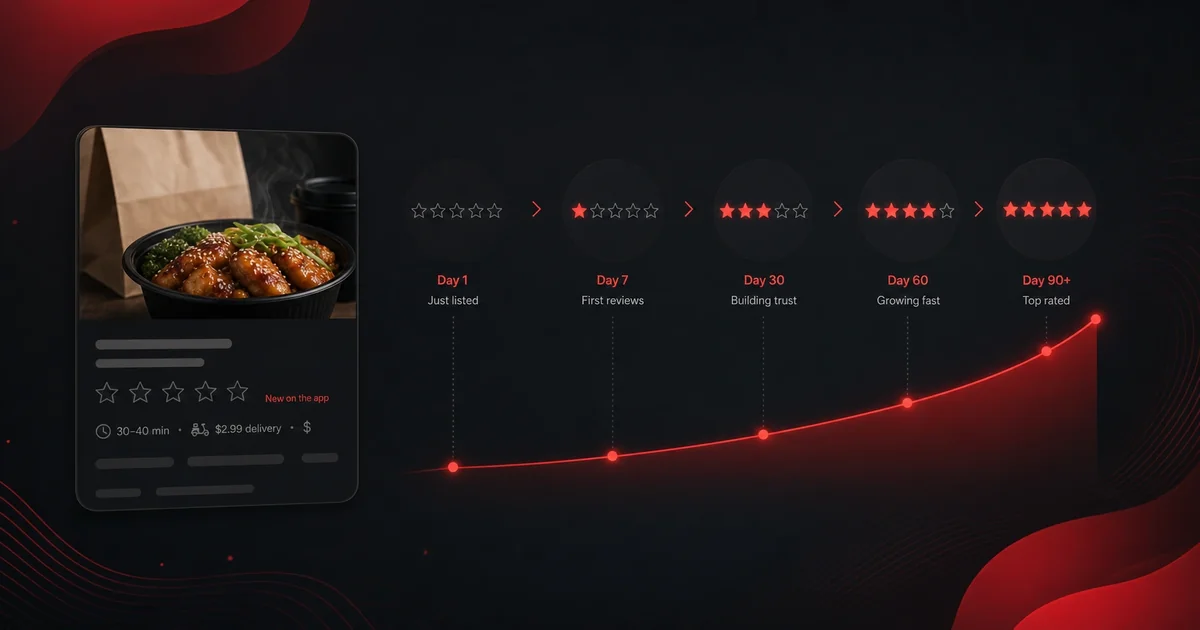
DoorDash cold start for a brand with zero reviews
Every DoorDash presence starts at zero. Every successful restaurant on the platform was once exactly where you are now: new, unknown, with no reviews, no history, no algorithm advantage. This is the cold start problem, and it's the most vulnerable phase for any restaurant launching on DoorDash. We've observed dozens of brands navigate this transition, and the pattern is remarkably consistent: what you do in the first sixty days determines your entire trajectory on the platform.
The Algorithm Reality
Here's what you're actually competing against that you can't see: DoorDash's recommendation algorithm is designed to optimize for customer satisfaction and retention. Every recommendation the platform makes carries an implicit guarantee — if a customer has a bad experience, they don't blame the restaurant, they blame DoorDash. The platform's reputation is on the line with every suggested restaurant. New restaurants with zero reviews are inherently high-risk recommendations because there's simply no data suggesting the food will meet expectations.
This isn't malicious intent from DoorDash. It's simple business logic: a customer who orders from a zero-review restaurant and receives a disappointing meal is likely to leave the platform dissatisfied, potentially permanently. The platform protects itself by favoring established restaurants with proven track records, legitimate review histories, and demonstrated consistency.
Your actual goal isn't to outperform established competitors in the algorithm — that's a losing battle in cold start. Your goal is to accumulate enough positive signals quickly enough that the algorithm begins treating you as a safe, recommendable option rather than a risky unknown. That's the entire cold start game.
What Actually Works During Cold Start
After analyzing dozens of successful cold starts, here's the pattern that produces consistent results:
Days One Through Thirty: Earn Your First Reviews
Your entire focus during the first thirty days should center on one objective: securing reviews. Everything else — discounts, advertising, menu variety — is secondary. Nothing else matters if you can't accumulate enough positive signals for the algorithm to trust you.
Here's the approach that works:
Resist the temptation to offer deep discounts. We understand it's counter-intuitive — the instinct is to attract customers with aggressive pricing. But deep discounts in cold start attract the wrong customer segment: price hunters who are notoriously difficult to please and leave the lowest lifetime value. Worse, they represent exactly the customer most likely to leave negative reviews when something goes slightly wrong. We see restaurants run thirty percent off specials for months, only to find themselves buried under negative reviews from customers chasing discounts instead of quality. Don't optimize for order volume — optimize for satisfaction.
Make every single order excellent. When a cold start order comes in, treat it as your most important order. The food should exceed your eventual standard. Packaging should be immaculate. Presentation should be memorable. You might not generate profit in cold start — that's expected. You're investing in reputation through quality.
Request reviews directly and thoughtfully. Here's a secret most restaurants miss: satisfied customers won't leave reviews unless prompted. The default behavior is simply not to bother. Include subtle review requests on your receipts, inside your packaging, in your confirmation emails: "Thanks for ordering from us! We'd love your feedback — leave a review at [link]" This approach generates reviews at three to five times the rate of restaurants with no request. It's not pushy — it's giving satisfied customers a simple action to take.
Leverage your existing network strategically. Your existing customers, friends, family, regulars — anyone who's tried your food and will leave honest positive reviews — should order in the first thirty days. Seed your review history with genuine reviews from people who actually experienced your food. This isn't review manipulation — these are legitimate customers who enjoyed your food and wanted to share.
Your actual target: at least fifty reviews within sixty days. That's the threshold where the algorithm begins treating you as an establishedRestaurant rather than a risky unknown.
Days Thirty Through Sixty: Controlled Promotion
With reviews now established and baseline data, you can begin testing promotional strategies with much more confidence:
Small promo tests with narrow scope. Try ten percent off specific items rather than thirty percent off your entire menu. Test specific menu categories instead of blanket discounts. Measure the response carefully, then immediately adjust based on data.
Only run promos during peak hours. Schedule promotions during your naturally busiest times when the algorithm is already predisposed to recommend you. Promoting during slow periods wastes promotional budget and attracts the wrong customer behavior.
Watch your review ratio carefully. If your review rate stays above 4.2 stars after implementing promos, you can scale. If promos attract discount-hunters and your ratings drop, reduce or eliminate promos immediately.
This is where you learn what your market actually responds to, with the safety net of a review history to buffer against minor issues.
Days Sixty Forward: Sustainable Growth Pattern
By day sixty, you'll have accumulated enough data to truly understand your market's behavior. Your reviews are establishing a solid baseline, and the algorithm is now treating you as a known quantity rather than a risk. At this point, you can optimize aggressively:
Menu engineering becomes critical. What's selling? What's generating profit? What's losing money? What should stay on your menu? This is where data-driven decisions replace guesswork.
Delivery optimization unlocks. What's your actual delivery radius impact? How does packaging affect food quality at different distances? What's your actual cost-per-delivery after platform fees?
Promotional discipline solidifies. You now know what drives your customers. Invest in promotions that deliver returns, eliminate what's wasteful.
What We See failing Consistently
We've witnessed brands fail at cold start through common, repeatable mistakes:
Running deep discounts immediately attracts price shoppers who generate negative reviews and represent the lowest lifetime value possible. We've seen restaurants run thirty percent off specials for months, unable to recover when their rating settles below four stars and they face an endless cycle of promotions just to generate orders.
Ignoring every review that comes in is fatal. Every complaint is a free opportunity to demonstrate customer service. Every negative review that goes unanswered signals to future customers that you don't care. The most successful cold starts respond personally to every review, building trust.
Attempting to be everywhere simultaneously divides your focus and review history. We recommend mastering DoorDash first before adding Uber Restaurants or GrubHub. Your reviews fragmented across three platforms dilute your credibility everywhere.
Inconsistent operations change nothing and guarantee inconsistent experience. The same menu, same quality, same experience. That's what builds a reputation. Constantly changing your menu creates unpredictable customer experiences and invites criticism.
The Actual Numbers From Successful Cold Starts
Here's what we consistently observe for brands following the playbook:
Days one through thirty: typically ten to thirty orders per week when focused on quality. This is a function of limited visibility plus your review-free status.
Days thirty through sixty: twenty to fifty orders with active promo testing. Growth builds naturally as the algorithm begins recommending you.
Day sixty and beyond: forty to eighty plus sustained orders with optimization. The growth compounds once you're established.
Review accumulation follows a similar pattern: fifty reviews by day sixty, one hundred by day ninety, two hundred-plus by day 180 for businesses running well.
These numbers are rough estimates — actual results depend entirely on execution and market. But the path is proven: patient quality-first execution wins.
The Patience Factor
This takes time. There is no shortcut to reviews, no cheat code for algorithm trust, no magical growth hack that skips the fundamentals. Your customers need to actually experience your food, be satisfied, and be motivated enough to say so publicly. That can't be faked, can't be purchased through ads, and can't be rushed no matter how talented your marketing team might be.
The brands that fail during cold start are universally those attempting to short-circuit this process. The brands that succeed accept the timeline and execute consistently with quality as the primary focus.
We're not naturally patient people in business. But cold start is where patience generates the greatest returns.
Close
DoorDash cold start is the most delicate phase of your entire platform presence. Your entire focus should be narrow: earn reviews. That's it. Everything else is distraction.
Don't get distracted with promos, discounts, or aggressive advertising that attracts the wrong customer profile. First sixty days: quality, review solicitation, patient execution. That's the proven path we see across successful restaurant brands.
If you need this kind of analysis on your market, locations, or category—not generic advice—tell us what you are deciding. We deliver ranked findings you can act on.