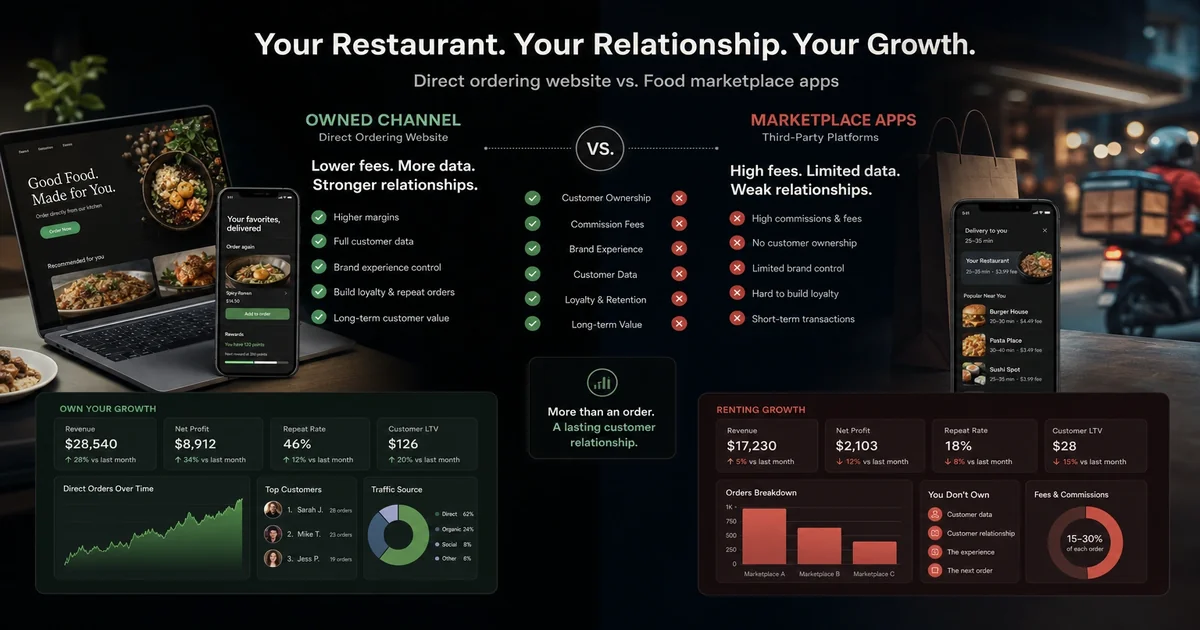
First-party ordering vs marketplace apps: architecture choices
The biggest architectural decision any restaurant running delivery makes is this: do you let customers order through your own website (first-party), or do you let the marketplace apps handle it (through DoorDash, Uber Eats, GrubHub)? This choice affects your margins, your data, your customer relationships, and your operational complexity. Here's how we think about it.
The Fee Problem
Every marketplace takes a cut. DoorDash's standard rates run 15-30% of an order total depending on the tier you're on, plus additional marketing fees for anything beyond basic placement. It's advertised as a platform fee, but the actual cost is the same thing: your money. Every restaurant we work with sees that line item on their settlement reports and knows it's where their margins go to die.
First-party ordering from your own website means no marketplace fee. You keep the full margin on every order. That's the obvious reason to build your own checkout flow. But here's the catch: it needs traffic, it needs to track what you're doing, and there's a lot that goes into building a checkout that doesn't include just accepting the card. We're going to break down when it makes sense to go first-party, when it doesn't, and the middle path that everyone's actually using today.
This isn't a binary choice. Almost every restaurant we work with runs both and we'll get to that hybrid model. But let's start with understanding each path.
Why Restaurants Still Use Marketplace Apps
We need to be honest: the main reason marketplaces exist for restaurants is they bring the customer. You're tapping into their app, their brand, their existing customer base, all of that user acquisition. You're paying for that access in the form of the fees, but that's worth it unless you already have a direct channel with customers so reliable that you don't need them.
When you're a brand-new restaurant with no digital presence, your first fifty orders often come through the marketplace platform. They are always going to be faster than trying to drive traffic from nothing to your own website. And there's also the fact that for the customer, the marketplace app is already on their phone. They have it installed, they've used it before, and their payment information is already in it. That simplifies the transaction on the consumer side, which improves conversion.
The last reason is the one that most restaurants don't think about: liability. When you handle payment on your own website, you're holding PCI compliance. You don't want that unless you're ready to do what's required. Using a marketplace handles that for you entirely.
Our job isn't to say never use a marketplace - they're there for the right reasons. Our job is to understand exactly when to lean into that versus pulling away from it towards the first-party model.
When First-Party Makes Sense
Now here's the part where we actually want to see that every restaurant we work with considers: your brand should own the direct customer relationship. That means your website, your app, your email list, your phone number. Everything that bypasses the marketplace and gets you a customer who knows they ordered from you specifically, that's your data, that's your brand. If you only ever exist in DoorDash, then you don't have a brand - you have a menu listing.
When you're in the marketplace and a customer orders through their app, you don't know if they've ordered from you before. You don't know what they typically order. You know that DoorDash knows all of that, they make it available to you only in aggregate after the fact. So you're running blind on one side, paying for everything and receiving very little data in comparison to what you'd have from your first-party system.
We'd rather have the restaurant own the direct relationship from day one - that's the philosophy at this point, and the reason they have their own ordering channel.
For every restaurant we're working with, we're telling them that first-party is the right play. At least with web ordering via their website, they see every order's exact revenue, all the customer data, and the revenue is all theirs. That's worth building for.
The Hybrid Actually Works
Here's what we see everyone doing:
- The first-party website captures your best, most loyal customers. It costs you nothing in marketplace fees. Every order there is more profitable than the same order placed throughDoorDash.
- The marketplace channel continues as a discovery and delivery channel. It brings you orders from customers who only use DoorDash and would never find your website. That's your customer acquisition that's worth paying for, and you'll take the margin hit. We don't see them refusing to do that.
- We use the marketplace for new customer discovery, and we move them to first-party ordering as quickly as you can. On each package you're shipping, on every delivery that's fulfilled, you want to insert a little flyer that says "Order directly next time, you're going to save fourteen percent." What the customer gets is a better deal, what you get is a better margin. That's what the entire business model builds on.
This is the model we help most of our restaurant clients implement. If you can bring them to your direct channel even a quarter of your orders, the savings on the marketplace fee per-order equals your marketing budget of getting them there.
What to Build First
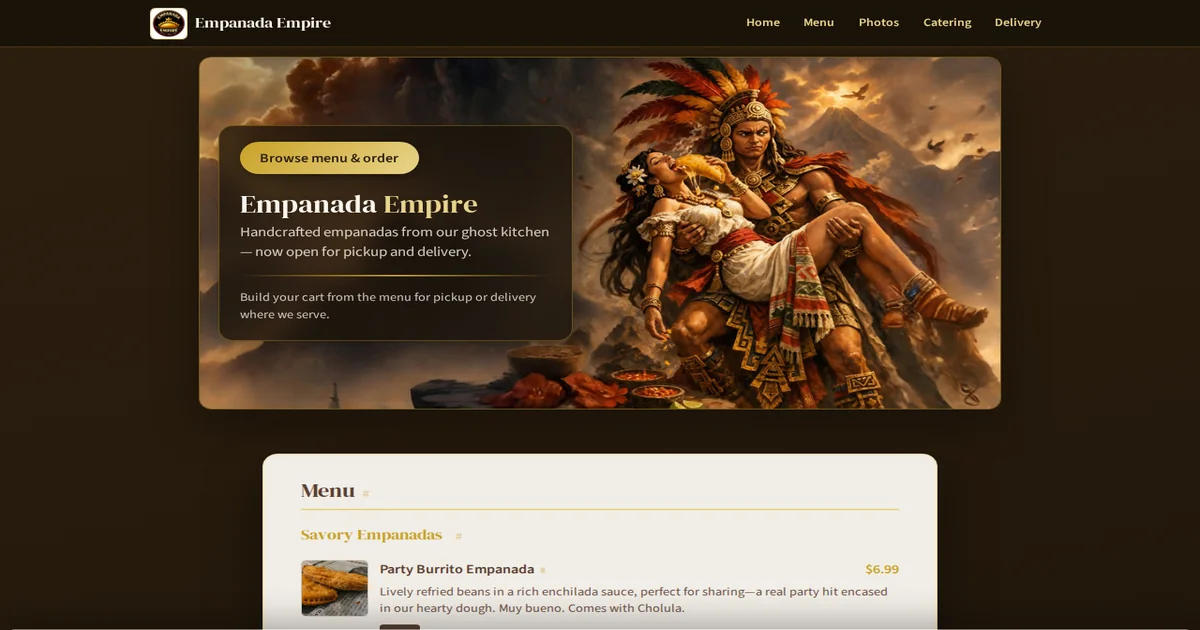
Here's the fastest way to start: build your own web ordering page. That's easier than most think. Build a simple web page, use Kitchen POS or any menu database to store your menu, build a quick cart with payment processor integration (Stripe has easy solutions for small restaurants and you don't need custom code to get that live and accepting payments). You can take a look at what we set some of our clients up with and replicate that - it's straightforward to add the payment processor with your credentials and go. This is the fastest way to start generating the first-party margin difference.
We built something we call "Kitchen POS" specifically that way. It connects into a web menu display and works across your delivery platforms, but we also use it as the source for the first-party web checkout. You're seeing a new item on your menu, we can just push that, and you're running this across your website. This gives you that immediate connection between your new item and that direct web ordering site. That's where we see our guys having the best luck.
If that's not realistic for what you're doing, any solution that gets you web ordering on your domain is good from day one. But you need your own payment processor. The moment you start using a different payment processor than what comes out of your POS - that's your first-party store.
Close
The choice between first-party ordering and marketplace isn't what we need the answer to exactly. The right answer is what you can manage as you're building. The best choice is what works as you need. And that's why we've built out the entire ecosystem we have. We're building the direct channel for restaurant owners, that's through no additional cost at all for the marketplace. You're already paying the marketplace for their share. You're not wanting to add extra on top of what's coming from that to build your own direct store, and that's exactly why the approach we use works.
If you need this kind of analysis on your market, locations, or category—not generic advice—tell us what you are deciding. We deliver ranked findings you can act on.