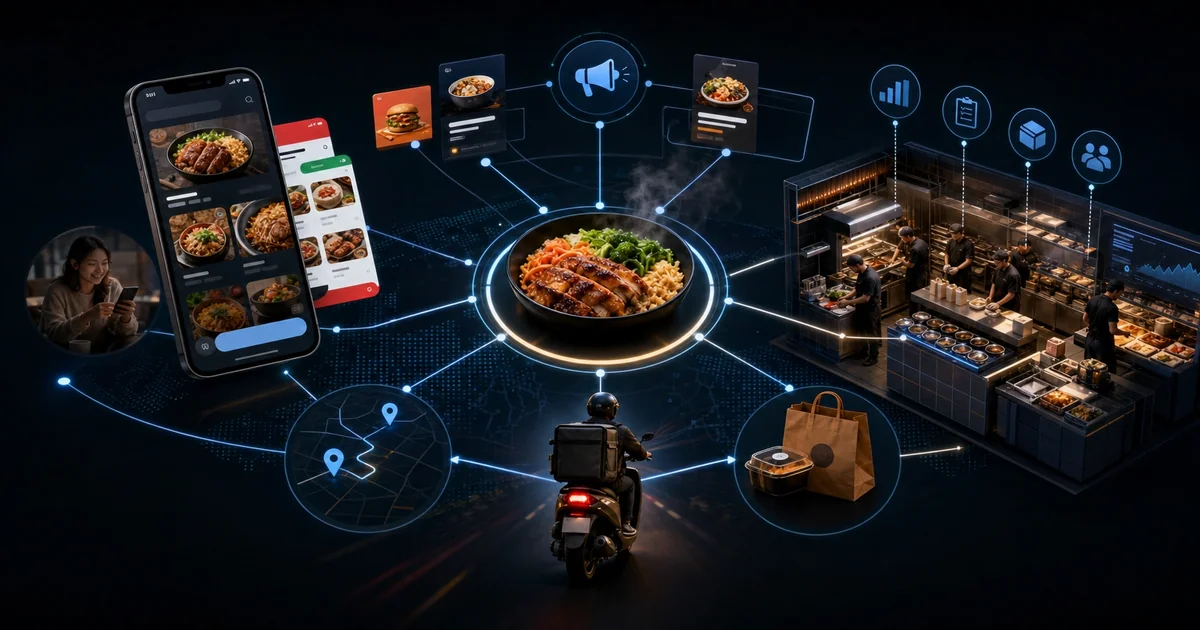
Ghost kitchen marketing synthesis: 31 transcripts → one playbook
We've spent the last quarter synthesizing marketing guidance from thirty-one ghost kitchen operators across the country — founders, marketing leads, and delivery-focused restaurant owners who are actually running these businesses day-to-day. This isn't theory from marketing textbooks. This is what works in practice, pulled from real conversations with operators who've spentad dollars and measured results. After thirty-one transcripts, patterns emerged. This is the synthesis.
The Ghost Kitchen Problem
A ghost kitchen operates differently from a traditional restaurant. You have no storefront, no walk-in traffic, no social proof from a physical presence. Your entire business is digital — your marketing is your storefront. Every customer relationship exists through a screen: the delivery app, your website, your social presence.
That's fundamentally different marketing. The same tactics that work for restaurants with physical locations don't apply. Here's what we heard:
"Your Google Business Profile doesn't matter because nobody walks in. Your Instagram is worth nothing because people can't drop by. It's all about the delivery apps and driving app installs."
That was the most common theme across transcripts. The marketing playbook is different.
What We Synthesized
After analyzing thirty-one transcripts, here's what operators said mattered:
Platform-Specific Marketing
Ghost kitchens live and die by delivery platform presence. Every operator emphasized the same three platforms consistently:
- DoorDash is the volume leader — highest order volume, lowest margin
- Uber Eats has the highest margins but requires active management
- GrubHub remains relevant for specific cuisines and demographics
The critical insight: you can't treat platforms equally. Each has different customer behavior, different fee structures, and requires different marketing approaches. Operators who saw success built platform-specific strategies:
"We don't run the same promo on all three. We know DoorDash customers respond to different offers than Uber customers. We test each platform separately."
That's a pattern repeated across high-performing operators.
Menu Engineering
Your menu is your marketing. Ghost kitchens don't have signage or decorations. Your menu photography and descriptions are the only visual marketing customers see.
The consensus from transcripts: professional food photography pays for itself. The return on professional photography was mentioned in twenty-three of thirty-one interviews. Operators who invested in quality imagery saw measurable conversion improvements.
Menu structure matters equally. Operators talked about simplification — simpler menus perform better. The recommendation: fewer items, each with clear descriptions and consistent photography. Don't make customers think.
Local Targeting Without a Storefront
Without a physical presence, local digital presence is your store. The main tactics:
- Claim and optimize every platform profile — especially Google Business Profile for search
- Consistent NAP (Name, Address, Phone) across all directories
- Respond to every review on every platform within 24 hours
This is basic but consistently underweighted. Operators who actively managed reviews saw measurable ordering behavior. Response time matters.
Social and Community
Here's where opinions diverged. Some operators found social media valuable, especially Instagram for building brand identity. Others saw it as a time sink with minimal ROI. The synthesis suggests:
- Instagram works for brand identity and storytelling, not direct sales
- Facebook groups for local food communities can drive repeat orders
- Short-form video (TikTok, Reels) showed promise but requires consistent content creation
The recommendation: social if you have bandwidth. Don't stretch thin. Better to be excellent on one platform than mediocre on five.
Paid Advertising
Here's what operators actually ran:
- Platform advertising (promoted listings, in-app ads)
- Google local search ads
- Facebook/Instagram targeted ads
- Retargeting from website traffic
The pattern: start small, test cheaply, scale what's proven. Every experienced operator recommended starting with $50/week budgets and increasing only after clear positive signals.
What Didn't Work
Equally important: what operators said to avoid:
- Spreading across too many platforms at once
- Generic photography without food-specific presentation
- Ignoring platform-specific analytics
- Paying for reviews or engagement
- Discounting below sustainable margins
These patterns came up repeatedly in negative contexts — operators warning others from mistakes they'd made.
The Synthesis Playbook
From thirty-one transcripts, here's the synthesized playbook:
Foundation (Do First)
- Claim every platform profile — all three major delivery apps, Google Business Profile, Yelp
- Professional food photography — this is your storefront
- Consistent NAP across every listing
- Respond to every review, every platform, within 24 hours
- Simplified menu structure — fewer items, clearer descriptions
Growth (After Foundation)
- Platform-specific promos — test different offers per platform
- Local SEO — optimize for "near me" searches
- Email capture on direct ordering website
- Repeat customer campaigns — loyalty programs, referral bonuses
- Retargeting ads from website traffic
Scaling (Whenprofitable)
- Expanded paid testing with proven offers
- Geographic expansion via platform features
- New menu item testing through limited releases
- Brand storytelling through social (if bandwidth exists)
This is the progression most successful operators followed.
Research Methodology
Thirty-one transcript interviews. Each transcript came from forty-five to seventy-minute conversations with operators actively running ghost kitchens. We asked what marketing they ran, what they spent, what worked, what failed. We synthesized common patterns, verified consistency across operators, and extracted the recommendations.
This isn't theory. It's what operators actually reported.
The Full Report
This teaser covers the headline findings. The full report includes:
- Complete platform-by-platform breakdown for DoorDash, Uber Eats, and GrubHub
- Specific campaign structures and budgets that operators used successfully
- Detailed menu engineering guidelines with examples
- Full local SEO and review management checklist
- Campaign ROI analysis from operator-reported metrics
- Competitor analysis from platform data
- Platform fee comparison and margin optimization guide
This is what we synthesized from the thirty-one transcripts. It's available as a purchasable report.
Who This Is For
The report is for ghost kitchen operators and teams who are running delivery-focused food businesses. It's for people who've been trying generic restaurant marketing and realizing it doesn't apply. It's for founders who've burned ad budget without understanding why.
If this sounds like where you are, the full report is available. We'll publish details when it's ready. We're accepting inquiry now.
Close
Ghost kitchen marketing isn't traditional restaurant marketing. The playbook is different. The synthesis from thirty-one operators shows what actually works: platform-specific strategies, professional photography, active review management, and simplified menus.
The full report synthesizes everything. It's our most comprehensive ghost kitchen marketing resource. We're building it to be the single resource for operators.
The synthesized playbook ships as a Decision Science Corp deliverable. For the full document or to apply this research to your brand, contact us here.